Beyond Rhetoric: Decolonial Practices in Museums and Cultural Spaces
Museums and cultural institutions – in their role as crucial agents of postcolonial societal transformation – are increasingly focusing their attention on the persisting societal challenges of racism, xenophobia, and forced displacement. In the spirit of bringing diverse communities of peoples together, and more importantly, to join the call to action for “decolonisation”, exhibitions often showcase artworks and artefacts of peoples from the Global South. These exhibitions show that museums are not simply places where artworks and artefacts are displayed. They are also places where societies tell stories, decide whose experiences matter, and shape how audiences understand each other.
This creates an important question that is impossible to ignore: if museums and cultural spaces want to contribute to societal change and transformation through decolonial practices, how should they work with the marginalised stakeholders whose lives are being represented?
“Decolonising” museums begins with recognising that these cultural establishments were created within systems shaped by centuries of colonialism and colonial histories. Objects, knowledge, cultures, and stories have often been collected and interpreted by institutions in power, while the people connected to them had little say in how they were represented. Therefore, decolonising museum practice means more than simply changing labels, returning objects, or hosting new exhibitions. It also calls for conscious and meaningful efforts at changing who gets to speak, who gets to decide, and who is treated as an equal partner in creating and sharing knowledge.
This is especially important when museums and arts-based researchers work on collaborative projects involving racialised migrant communities and stakeholders. Although these issues directly affect these communities at systemic and interpersonal levels, they are often not sufficiently represented in the research and executive decisions that concern them. This inevitably calls to question their representation and agency: Who is involved? Who is this work for? Who is speaking, and for whom?
These questions matter because representation is not simply about token visibility. It is also about having a meaningful voice. When cultural institutions speak “for” or “on behalf of” marginalised and historically underrepresented communities without giving them a genuine opportunity to shape the work, their knowledge and perspectives get pushed aside.
This creates a severe lack of agency for the concerned marginalised peoples. Being represented in an exhibition or mentioned in a research report does not necessarily imply having control over how one is represented. It is possible for a community to be the subject of a project without having helped decide its goals, execution, or outcomes. In fact, this is the most conventional and convenient route that eventually gets adopted. Naturally, this is particularly troubling when the topic demands sensitivity and mindfulness, and has direct consequences on the lives of the concerned marginalised peoples. As Gayatri Chakravorty Spivak reminds us in her 1988 essay, “Can the Subaltern Speak?”, speaking on behalf of others can easily become a way of speaking over them.
Another issue is active accountability. Institutions often respond to the consequences of prejudice while paying little attention to the systems and attitudes that produce those harms. When discrimination occurs, the burden of coping with it can fall heavily on the people who experience it, while institutions are not always required to examine their own role.
This perhaps also raises a more useful question for museums and arts-based researchers: instead of only documenting prejudice and its consequences in the postcolonial world, how can we help prevent harmful attitudes from developing or becoming stronger? How can we try to alleviate them?
Art may provide an answer but unfortunately only a part of it. Because art can create emotional experiences, invite reflection, and encourage people to encounter perspectives different from their own, it has the potential to support more open and caring ways of relating to others. However, this potential is not automatic, and most certainly not straightforward. An exhibition does not become inclusive simply because colonialism or forced migration is its subject. The process of making and presenting the exhibition must also be rooted in a compassionate, respectful and accountable approach that prioritises the agency and wellbeing of the marginalised stakeholders.
A practical way forward is to build a shared framework for collaboration and co-creation. This framework – rooted in the values of genuine solidarity, empathy and allyship – needs to be reflected in real, tangible decisions, not simply written into mission statements.
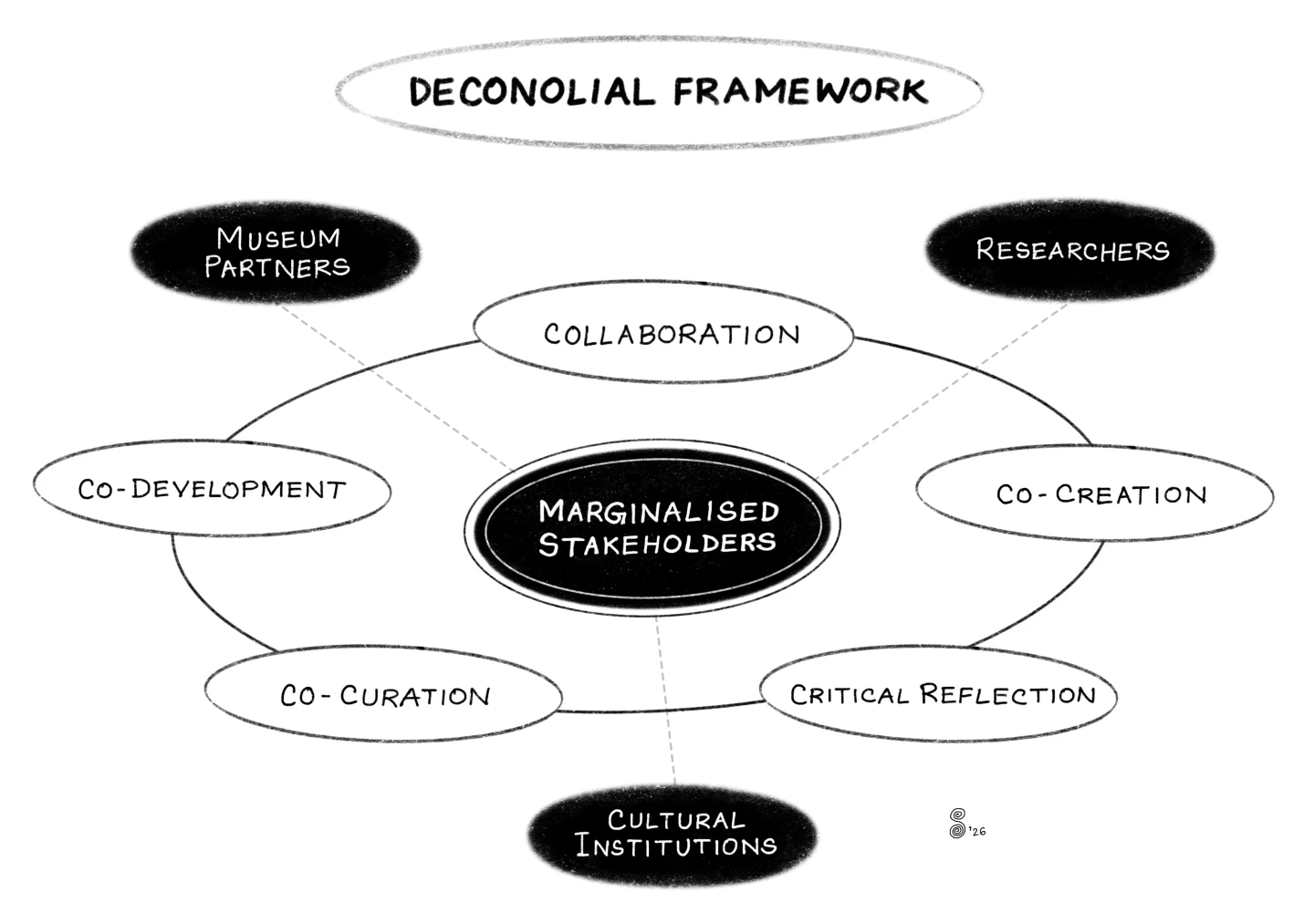
First, museums, cultural spaces, and researchers should proactively collaborate with racialised migrant artists, activists, and community stakeholders from the beginning of a project. They should not be invited only after the main decisions have been made. Their knowledge should shape the questions, stories, and form of the project. Emerging forms of citizen science offer useful examples of how people outside traditional research institutions can become genuine, equal partners rather than passive participants.
Second, migrant stakeholders should have a central role in developing and leading exhibitions about migration and displacement. Co-curation should mean more than asking for comments on a finished exhibition. Community partners should help decide which artworks are shown, how they are categorised, what language is used, and what audiences are likely to take away. Where final decisions cannot be shared equally, institutions should explain how community feedback influenced the final outcome.
Third, museums and research institutions should create spaces for critical reflection that are led or supervised by the communities most affected by the work. Workshops with migrant artists, activists, researchers, and other stakeholders can provide opportunities to question institutional assumptions, identify unintended harms, and discuss whether a project is meeting its aims. Institutions should be prepared to change their practices in response.
This approach also changes the meaning of expertise and knowledge. Who gets to define expertise and knowledge? Expertise and knowledge do not solely belong to curators, academics, policy-makers, or museum professionals. People who experience racism, xenophobia, forced displacement, or social exclusion hold expertise and knowledge that cannot be objectively replaced by statistics or outside perspectives alone. Taking that knowledge seriously would mean proactively bringing together different forms of knowledge gained through lived experiences, and allowing each to influence the final decisions. It would mean steering away from homogenising their complexities and nuances, and embracing the intersectional nature of the lived experiences of marginalised peoples.
A genuinely decolonial museum is therefore not defined only by what it displays. It is defined by how it operates from within. It asks who has power, who benefits, whose knowledge and expertise are valued, and who is accountable when something goes wrong. Museums and cultural institutions must be willing to share power, listen when they are challenged, and accept that meaningful collaboration may change the direction of a project.
For arts-based research, this is equally important. Research involving marginalised communities should not treat people merely as sources of stories, data, or emotional experiences. They should have opportunities to shape the work, question its assumptions, and influence its outcomes. This not only makes the endeavour ethically robust, but also utilises the opportunity of truly serving the people it intends to serve.
Decolonising museum and cultural spaces is ultimately about moving from speaking about people to working with them. It is about replacing one-way representation with dyanamic co-creation, passive consultation with meaningful collaboration, and good intentions with actionable accountability. Museums must become spaces where diverse communities do not merely appear in the story as token representatives but help write the entire narrative. If art is to contribute to social transformation in a postcolonial society, then the process through which that art is researched, created, curated, and shared must itself reflect the more equitible and compassionate society it hopes to inspire.
"Decolonization is not a posture; no institution can be decolonial unless society is decolonized, and the museum does not exist outside the social world that created it."
Last but not the least, it is essential to remind ourselves that museums and cultural spaces do not exist in absolute social isolation. They are part of the very society that they set out to benefit in the first place. In fact, they are fundamentally molded by it. Thus, decolonisation of museums and cultural spaces cannot miraculously happen without involving the society at large. This means, it would also require decolonial practices to be implemented in parallel across all other social establishments and insitutions (e.g., education, healthcare, government, economy, etc.) As with all systemic and structural changes in humankind’s history, the process might be long and arduous but never impossible.
The Author