What is the Way Forward Designing for Children in Museum Environments?
At Nissen Richards Studio, we have recently finished a series of exhibitions designed for family audiences, with a particular focus on younger children. It has made us think again about something that comes up repeatedly in exhibition design: how do you create an exhibition that works for children without turning it into a children’s exhibition?
Too often, museums can still be places where children instinctively feel that they should not touch, make noise or move too freely – but we very much wanted to make spaces that directly engage children – and families and independent adults, all at the same time. Is that really possible? Can different ages occupy the same exhibition, looking at the same objects and ideas, without one experience compromising another?
Four recent projects have allowed us to investigate these questions with interesting results – and some discoveries along the way.
Learning by Doing
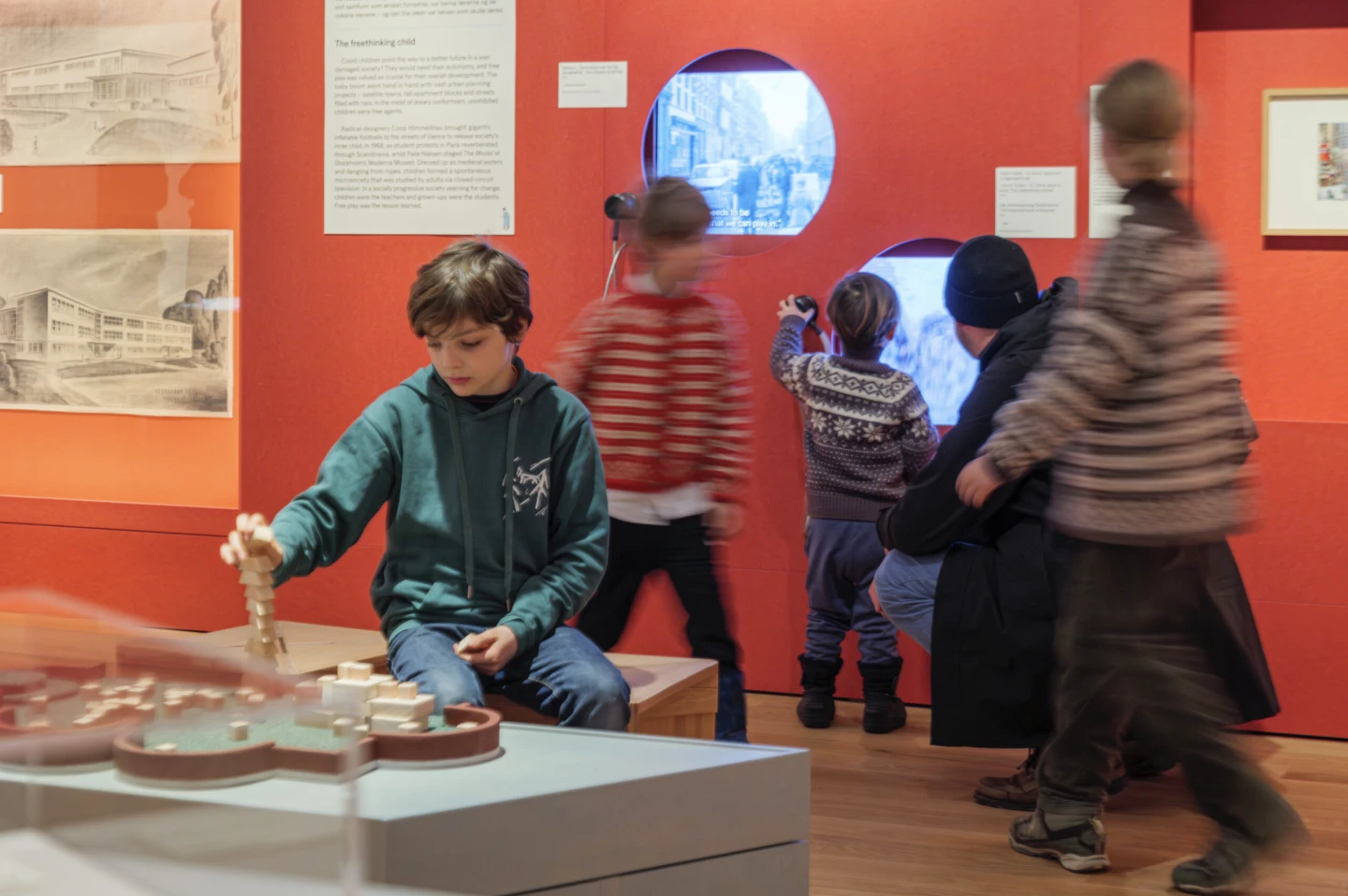
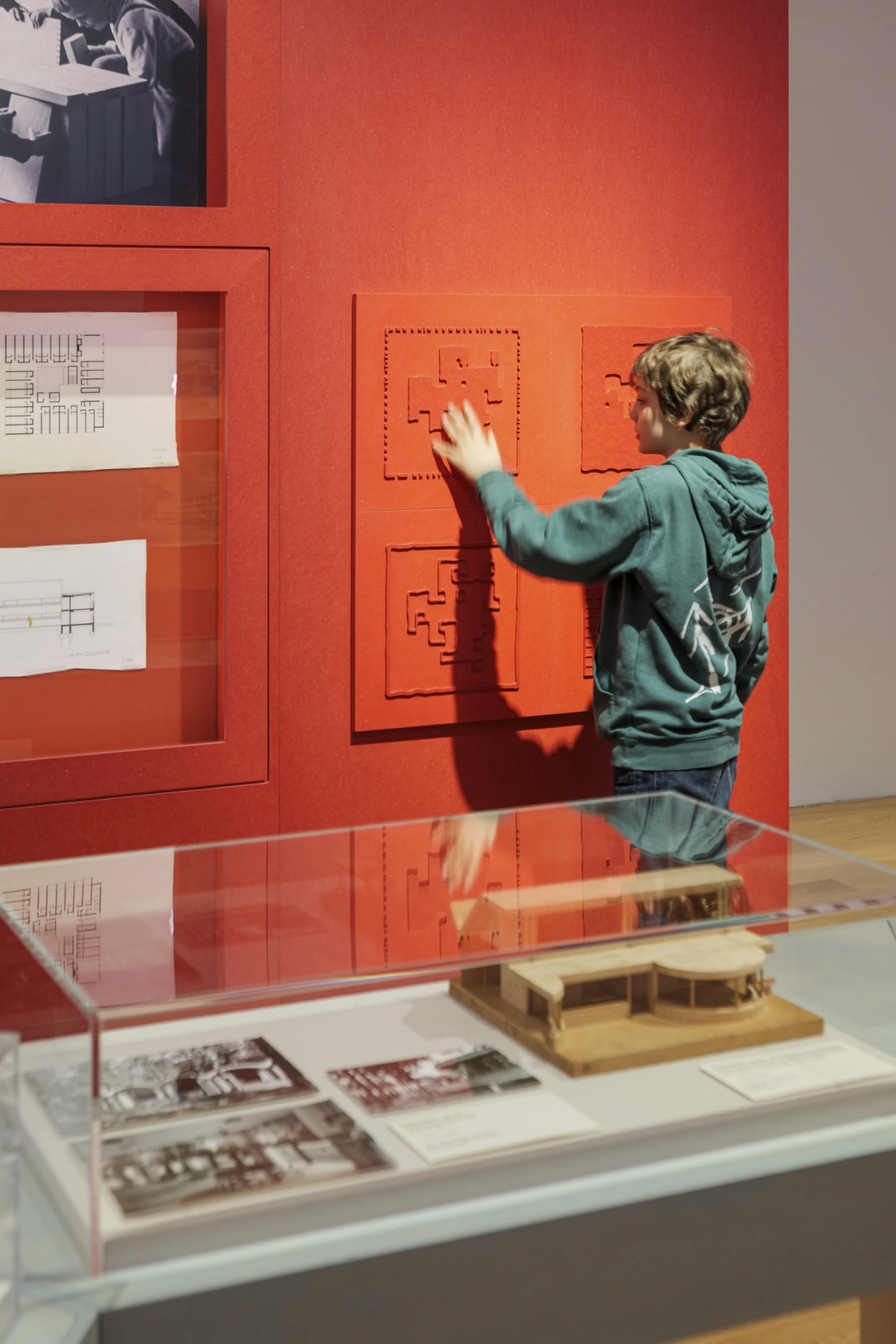
For ‘BOOM!’, an exhibition about children and architecture at the National Museum in Oslo, we were dealing with ideas that could easily feel abstract to a seven year old. How do you explain architectural concepts, drawings, plans and ways of thinking about cities to a child? Our approach was not really to explain them at all. Instead, we asked children to do things, and designed the exhibition so that anything could be touched (bar a couple of more sensitive items which sat behind protective screens). Advance workshops held with local children helped us to get difficulty levels just right.
Children were invited to draw over, make, build, rearrange and experiment. Architectural ideas were translated into physical actions, and rather than being told how architecture works, children could discover something about it through doing.
What was particularly interesting was watching the exhibition being used once it opened. We had imagined many of these activities being primarily for children, but families tended to do them together. Parents drew and children explained things to adults. Adults built alongside children, and the activity undertaken together became a common language.
There were also much smaller design decisions that changed the character of the space. Monitors were positioned lower and viewing openings in the cladding were circular rather than square. Displays were designed at different heights, but none of these things announced themselves as being ‘for children’, even though together they made the exhibition feel more approachable and gave younger visitors a greater sense that the space belonged to them too.
Perhaps this is an important distinction. Designing for children does not necessarily mean adding a separate children’s layer. Sometimes it is simply about removing the physical and intellectual barriers that prevent them from joining in.
Starting With the Familiar
For Imperial War Museums London, we faced a very different problem. ‘Children in War’ deals with difficult subjects and experiences, but its audience includes children themselves.
How do you introduce a child to something frightening or complicated without either overwhelming them or simplifying the subject to the point that it loses its meaning?
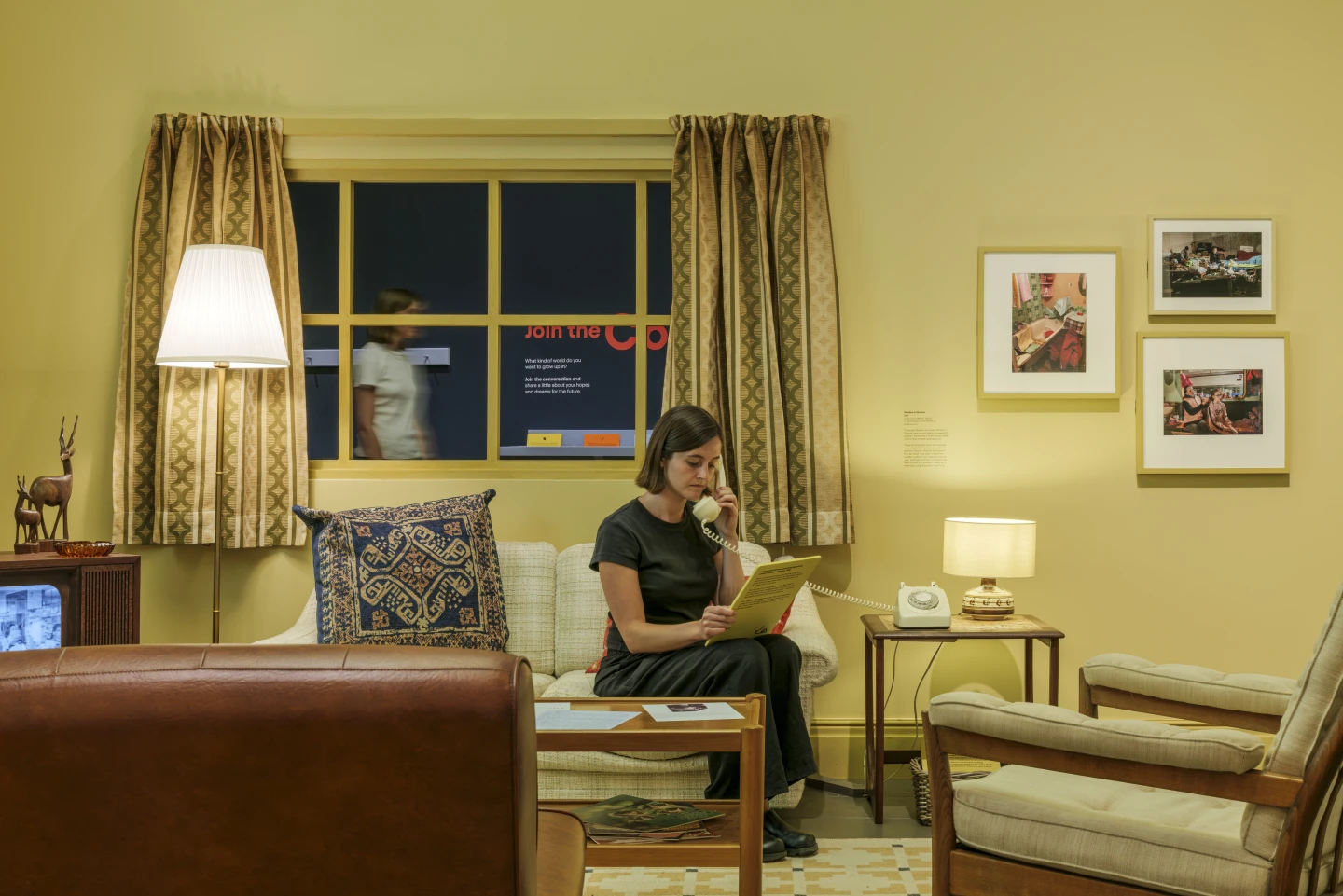
We decided to use our theatrical background, and begin with creating environments that the children would recognise: a bedroom, a sitting room, a schoolroom, a kitchen and a train carriage. They are somewhere between exhibition spaces and theatre sets and designed so that children can enter, explore and understand them initially as real places.
The familiarity relaxes younger visitors, and we placed our first space, a bedroom at the entrance. Children play and investigate, but embedded within these apparently ordinary environments are other stories. The bedroom or classroom becomes a way into understanding what happens when everyday life is disrupted by war.
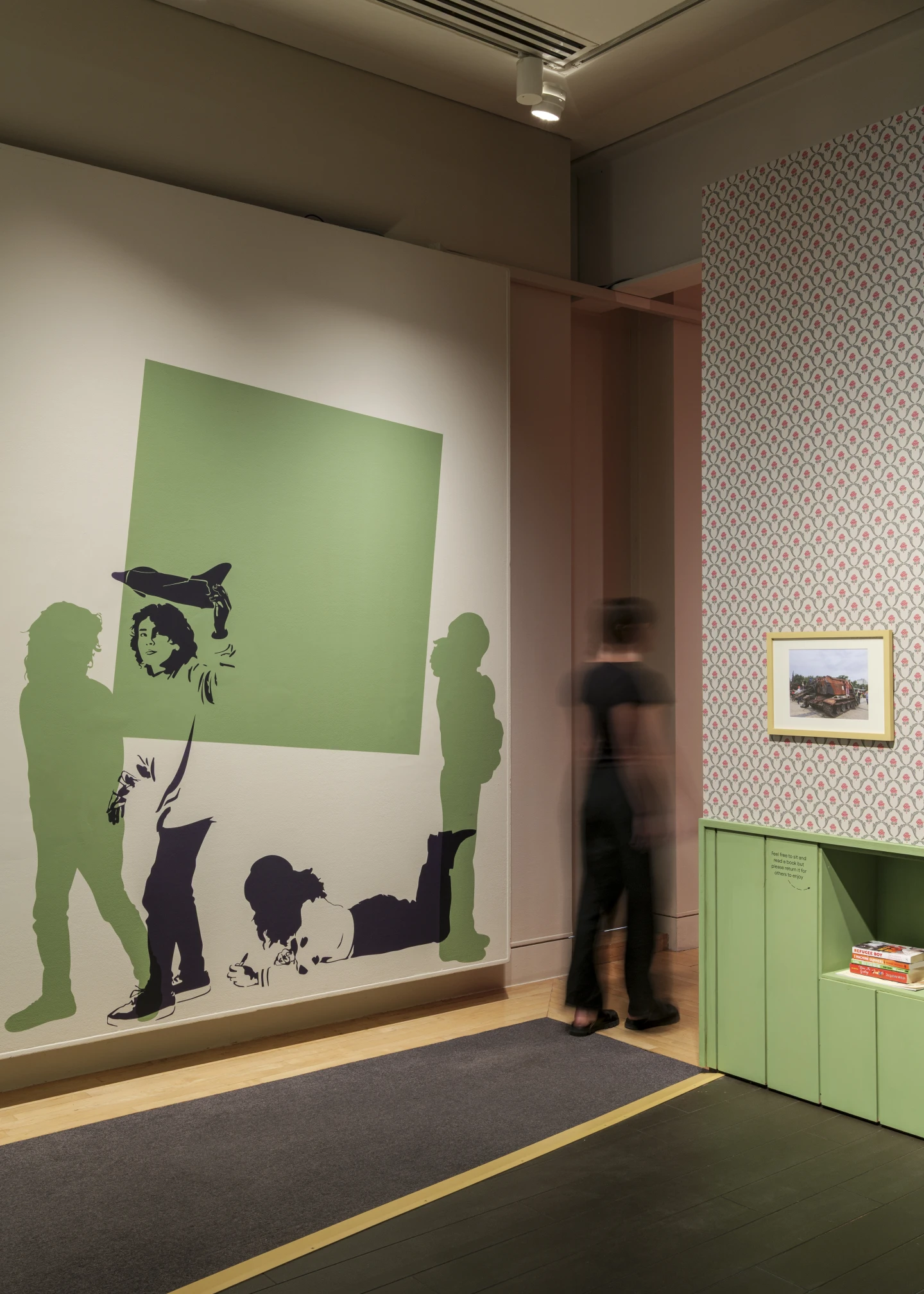
We also worked with our in-house illustrator and graphic design team to create a series of child characters who accompany visitors through the exhibition. We began by photographing children of different ages in a range of poses and activities and then developed these into illustrated figures that we stencilled onto the walls, like an abstracted photograph. They greet visitors on arrival and reappear throughout the exhibition, applied directly onto the walls.
The characters help to illustrate some of the ideas within the exhibition, but they also do something else. They are shown drawing, looking, playing, sitting, crouching or interacting with things. In a subtle way, they give children permission to behave differently within the museum: to get down on the floor, play, make something or investigate.
This idea of permission feels important and is something we think about a lot. Seeing another child represented as active rather than passive signals that different behaviour is possible here. The graphics become part of the invitation to participate, rather than simply another layer of interpretation. At the same time, adults can encounter these spaces differently, engaging with objects, testimony and deeper layers of information.
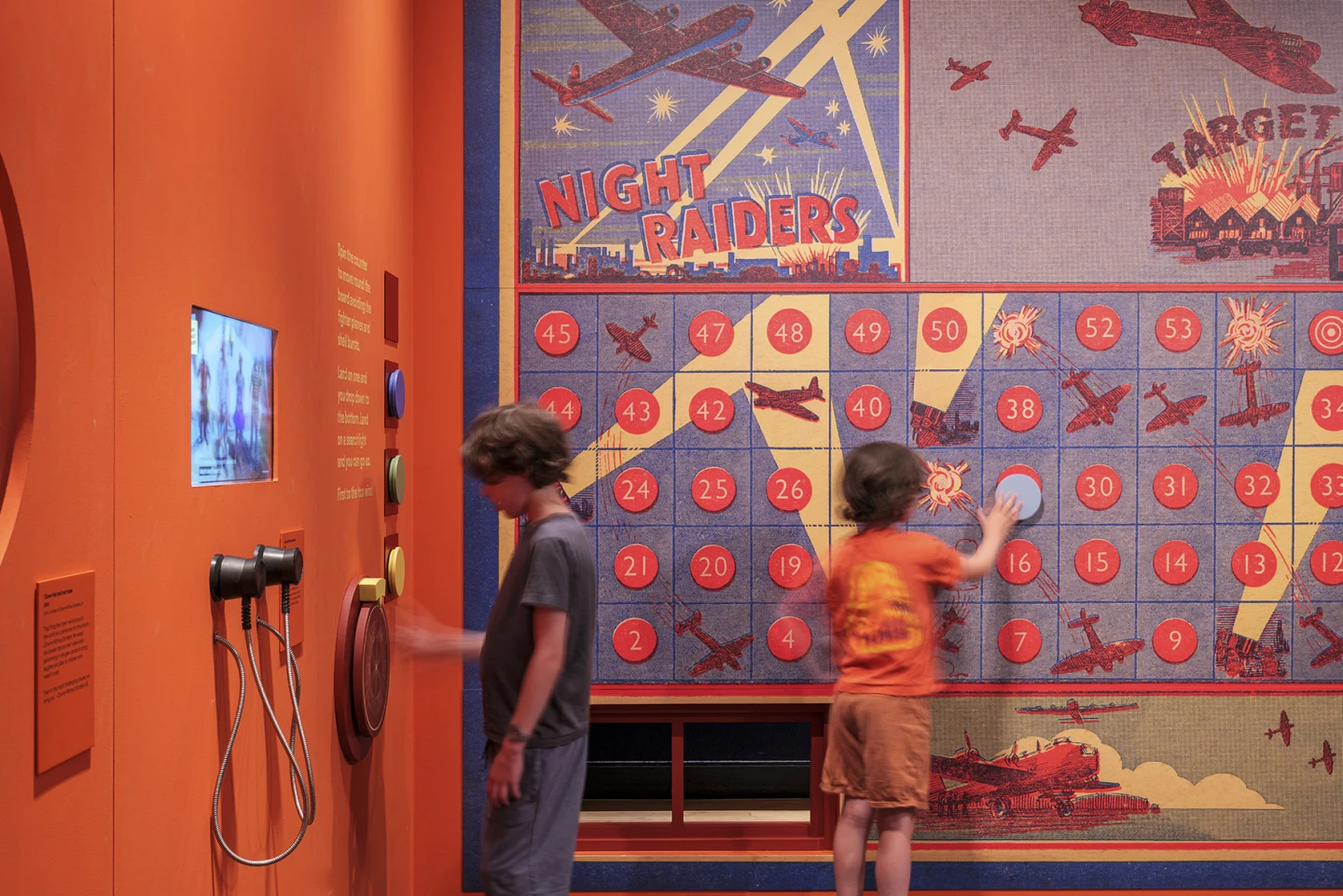
Watching families use the exhibition, what becomes interesting is that these different experiences can happen concurrently. A child might be discovering something physically while an adult is reading about it in greater depth. They are not necessarily doing the same thing, but neither are they separated. And afterwards, those different discoveries can become the beginning of a conversation. This seems particularly important when dealing with difficult subjects. Perhaps the exhibition does not have to explain everything to a child. It can provide a framework through which a child and adult can begin to talk about something together.
Making History Come to Life
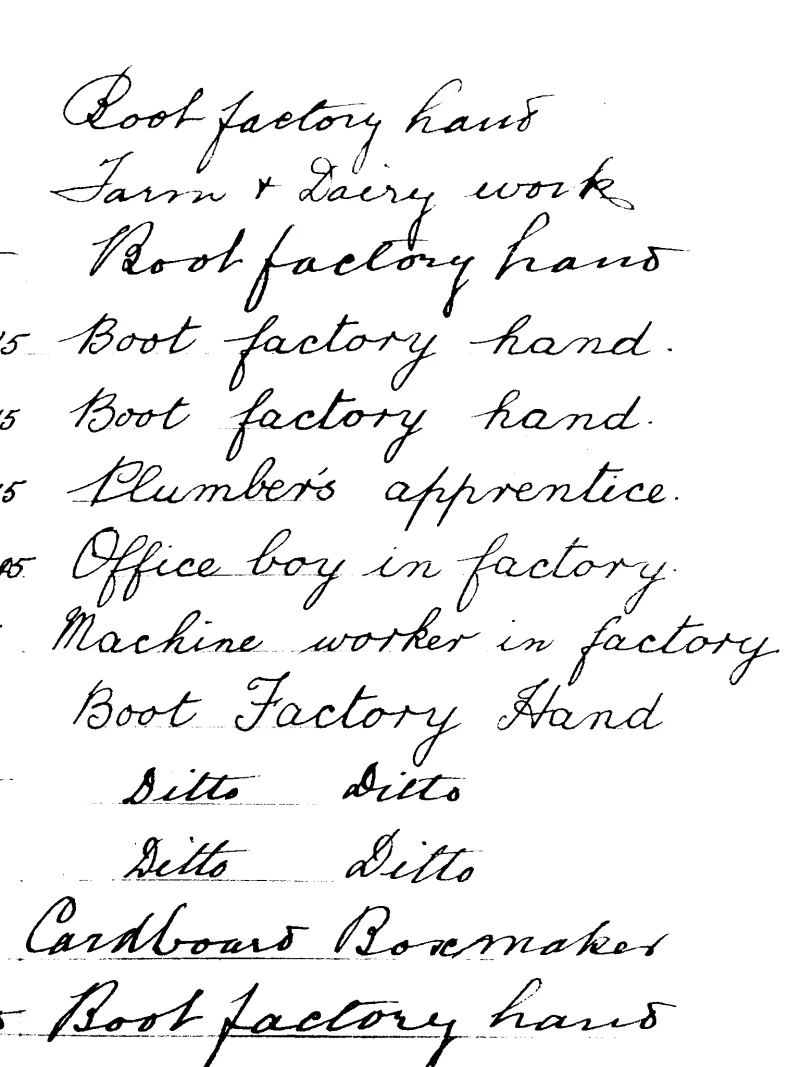
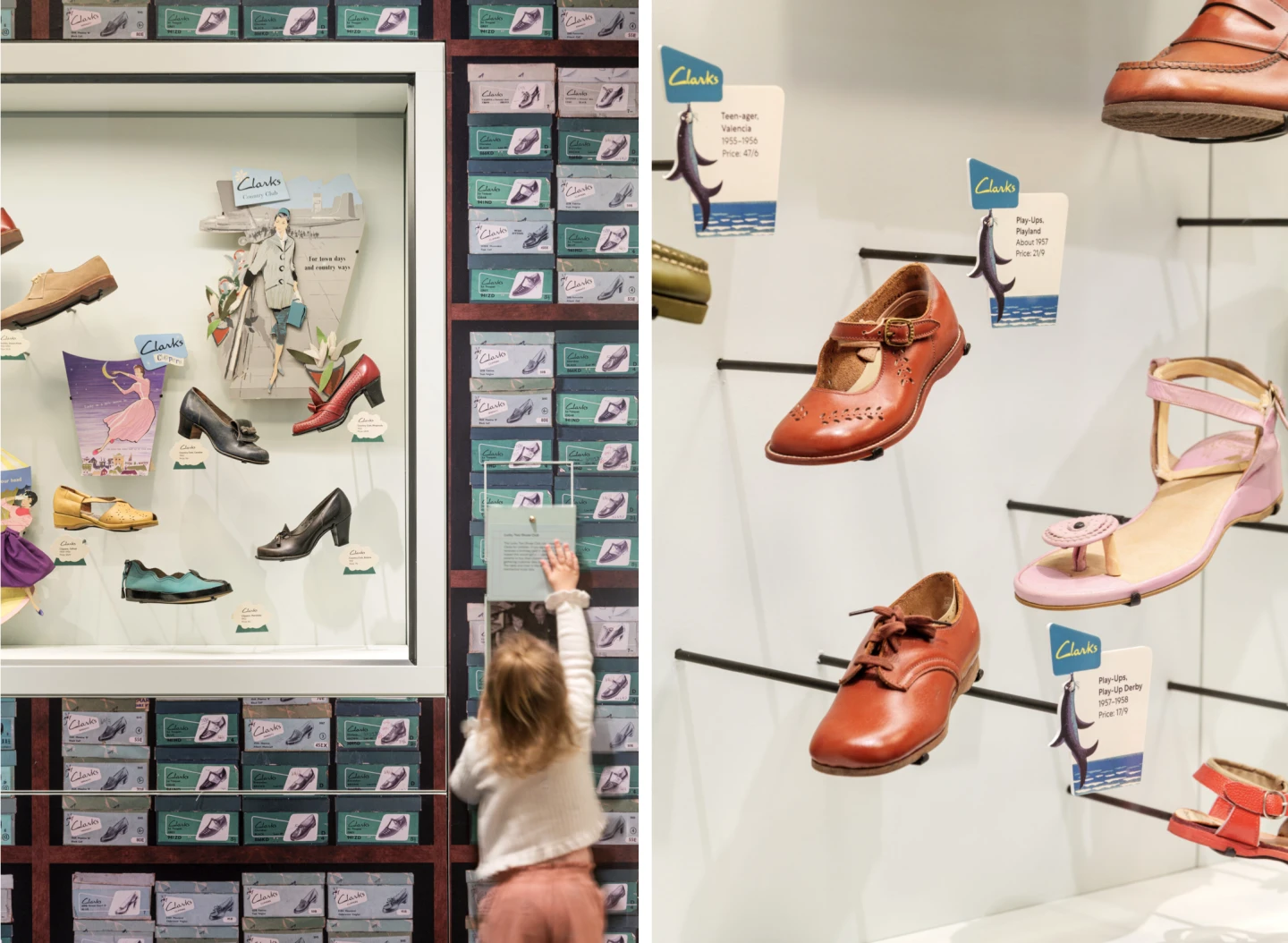
At the Shoemakers Museum in Street, Somerset, the subject was very different again, but some of the same ideas emerged. The museum tells the story of shoemaking and the history of Clarks and its connection to Street. Craft, making and materials are central to the experience, but so too is the history of the place and making shoes. The challenge was how to make that history feel immediate to a younger audience rather than something remote that happened to other people a long time ago.
Again, we found ourselves returning to action and doing. We broke down the process of making a shoe into a series of stages and developed physical interactives around them. Children could explore materials, processes and techniques, gradually building up an understanding of how a shoe is made by trying things themselves rather than simply reading about the process.
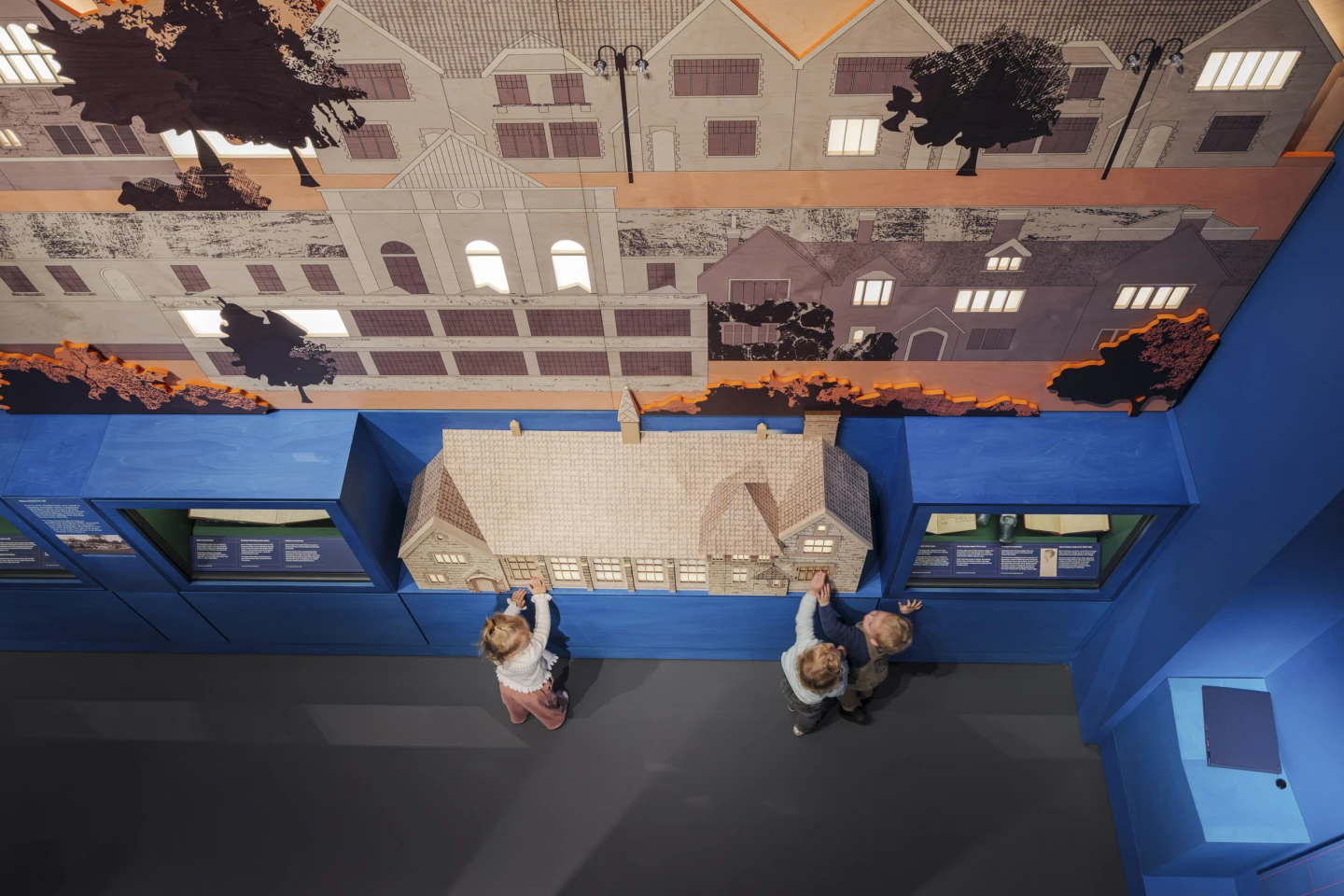
We also created models of different spaces that children could play with and explore, using physical activity as a route into understanding how and where people worked. Importantly, the historic photographs and archive material were directly connected to these activities. A child might do something and then see a photograph of somebody carrying out a related process many decades earlier. Rather than the archive material existing as a separate historical layer on the wall, it became evidence of people making, working, experimenting and doing things. This makes a subtle but important shift. History is no longer simply something to learn about. It becomes connected to an action happening now.
There was another layer to this around memory. Shoes are intensely familiar objects and shops, factories, advertising and domestic interiors can trigger very particular recollections. We created recognisable environments as a way into the story, including a shoe shop from another era. For a younger visitor, the shop is something unfamiliar to explore. For an older visitor, exactly the same space might prompt recognition by remembering shops like this. It is almost like an environment that is historical to one visitor can be autobiographical to another.
This approach creates an interesting exchange between generations. A grandparent might explain something to a child through their own memory, while elsewhere the child might understand a process through an interactive and explain it back to them so that knowledge does not travel in only one direction.
Perhaps this is another way of thinking about history in exhibitions for children. Rather than presenting the past as something finished and distant, we can connect it to an action taking place now. A child makes, builds or experiments, then looks at an image from fifty or a hundred years ago and recognises that same action. The distance between then and now suddenly becomes much less significant.
Designing for Different Levels
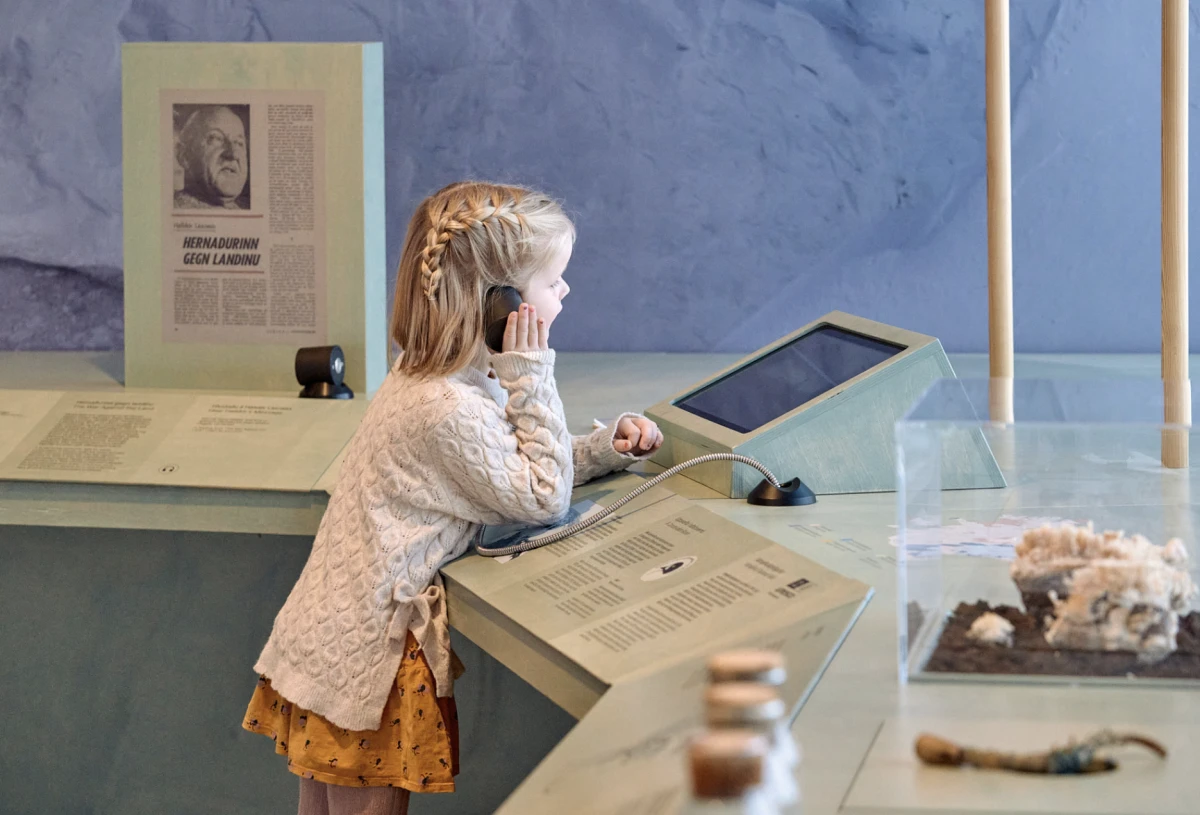
At the Gígur Visitor Centre in Iceland, designed with local architects SP(R)INT, we had two complicated tasks – one was how to create an exhibition about the natural world when the natural world itself is immediately outside the building and visually surrounding the exhibition and secondly, how to ensure children immediately felt at ease in the space?
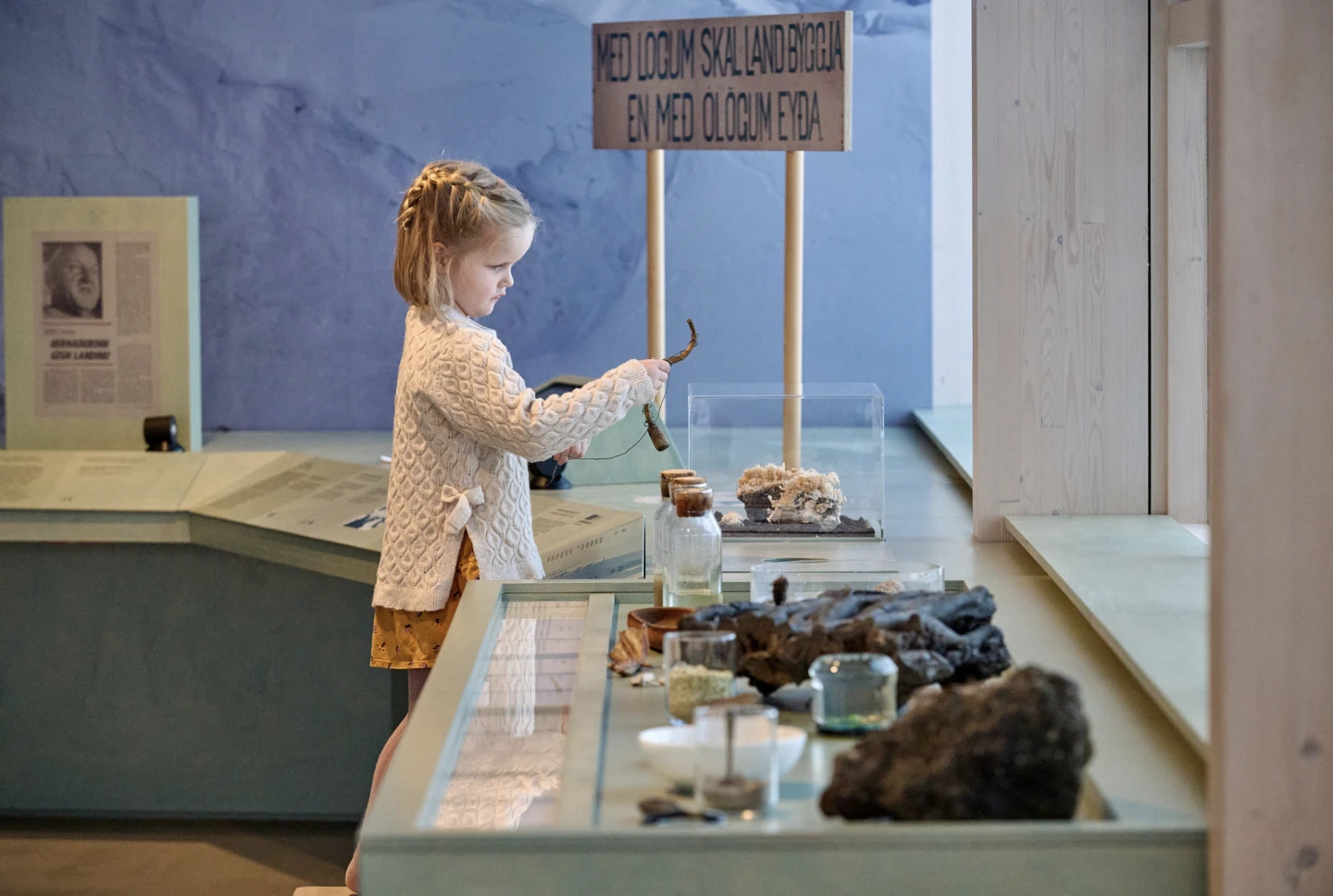
One of the most important decisions here was therefore about what not to do. Rather than filling the room with exhibition structures, we designed a continuous table that sits below the height of the window sills. When you enter, your overwhelming impression is still of the landscape beyond. The exhibition does not compete with the thing it is trying to explain, the landscape remains present as the primary exhibit. The table then provides multiple layers through which to explore it.
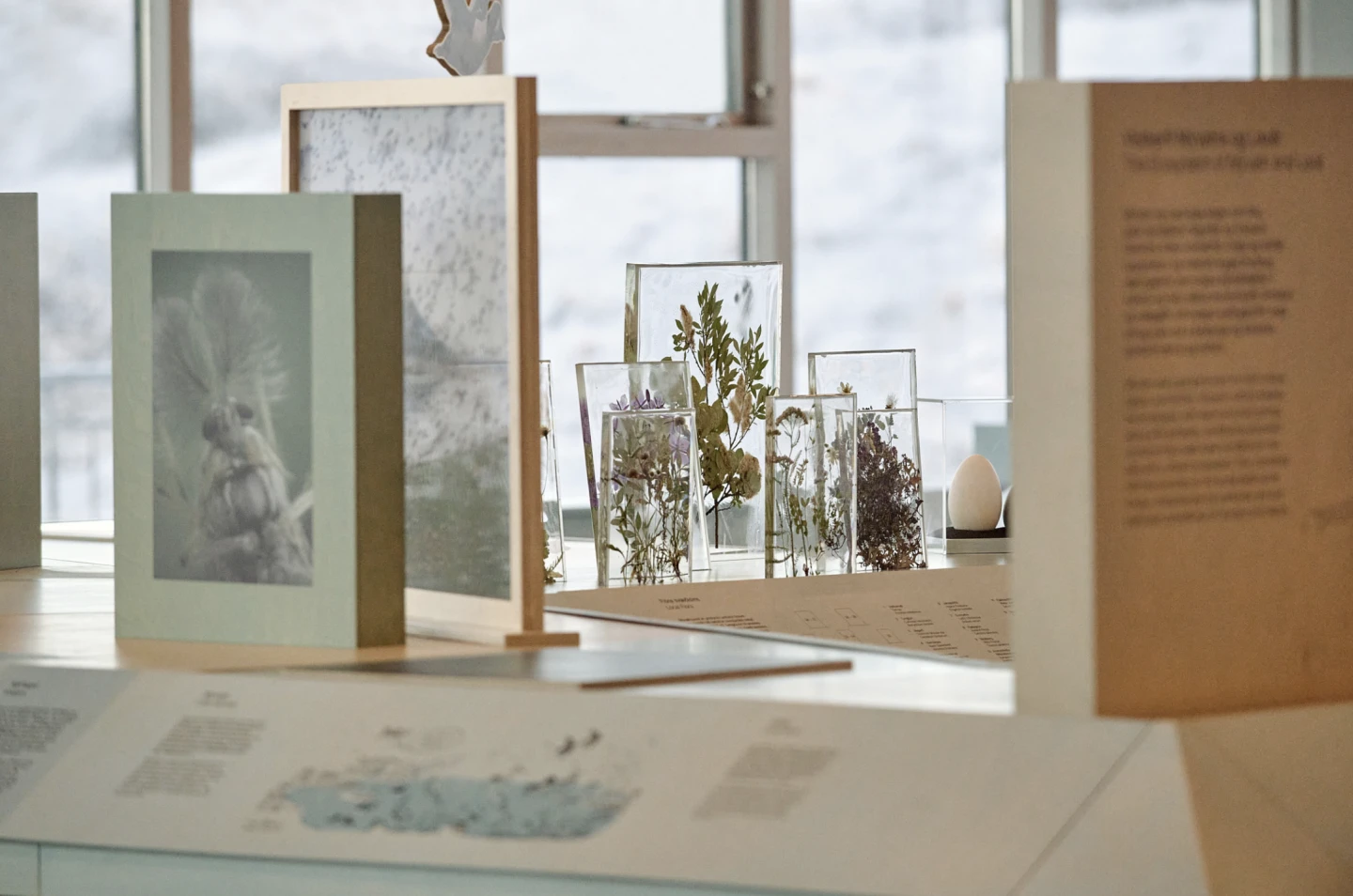
A continuous rail runs around it with information, drawings and illustrations. Above and beyond this are models that can be touched, specimens and objects in cases, and things that can be picked up, moved and examined. Visitors can also bring things in from outside and use the table as a place to collect, compare and explore what they have found.
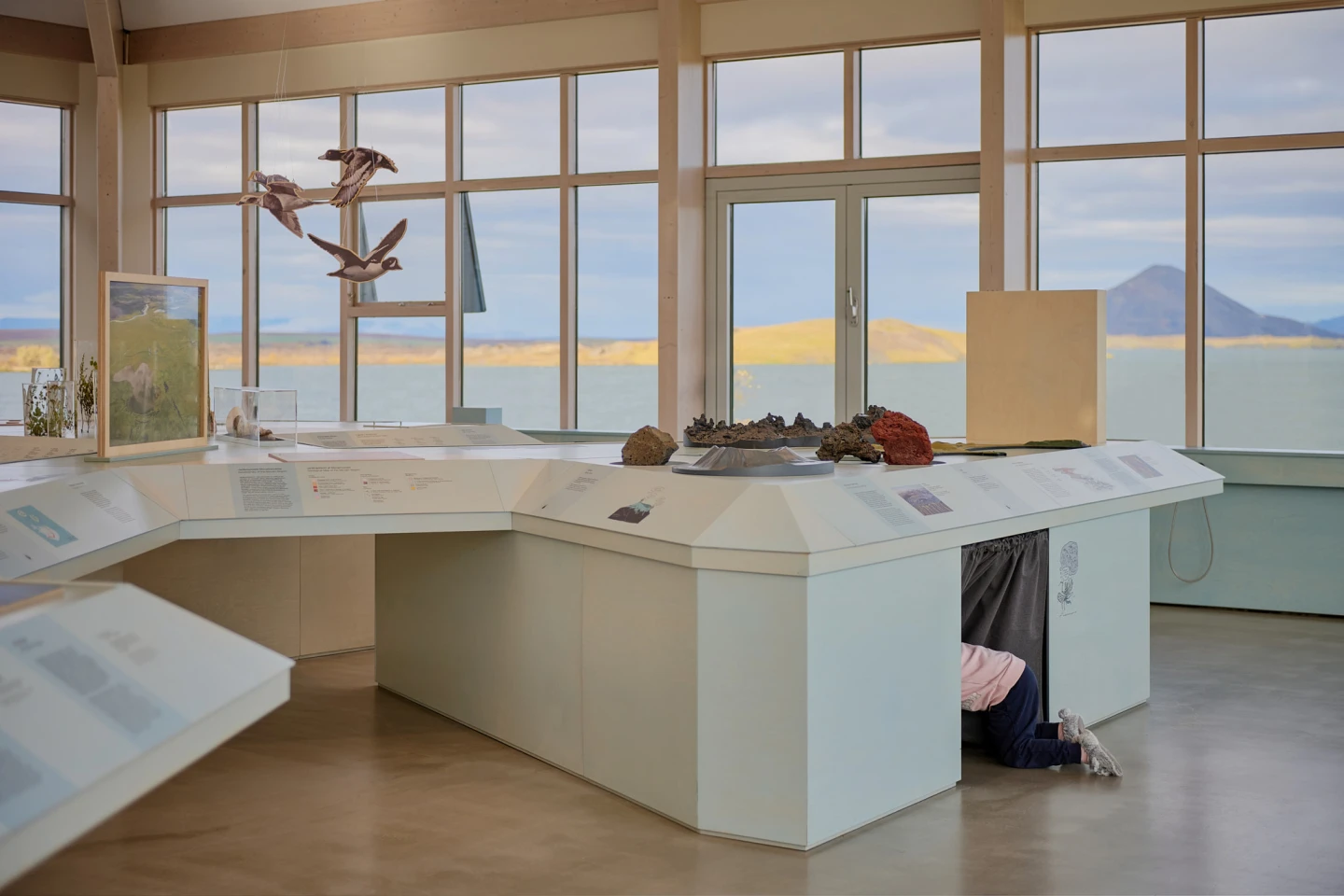
We worked with a local illustrator to develop characters from some of the wildlife found around Mývatn. These run through the exhibition and animate the more factual information, but some of them also exist at a different physical level. The midge, for example, appears lower down, closer to a child's eye line. Other elements are similarly hidden or positioned so that children encounter them. There are raised drawn surfaces from which they can make rubbings and small spaces only they can crawl into. Inside, drawings are hidden in darkness and can only be discovered using an infrared torch. This creates a different kind of hierarchy, where the adults do not necessarily find everything first.
A child can disappear underneath the table, discover something hidden and call an adult over. They can spot a character that an adult has walked past or find something because they are closer to the floor. Their scale becomes an advantage rather than something the exhibition has to accommodate. At the same time, all of these discoveries sit within the same overall exhibition. An adult might be reading about the ecology of the lake while a child is searching for an animal hidden beneath the table. They are approaching the same subject through different routes and at different physical and intellectual levels.
Crucially, everything continually refers back to the landscape outside. A drawing, specimen or model can prompt you to look through the window and then perhaps go outside and find the thing itself. The exhibition becomes less an explanation of the landscape than a tool for looking at it more closely.
Experiencing Together in Different Ways
Looking across these four exhibitions, perhaps the question is not really how we design current and future exhibitions for children but how we design exhibitions that allow people to encounter the same ideas at different depths, or in different ways?
Children do not necessarily need a parallel experience or distraction, separated from the ‘real’ exhibition. They need different ways into it: through doing, making, playing, touching, recognising and imagining. Adults might become interested through an object, a piece of text, a memory or a more detailed layer of information. Neither route should diminish the other.
There is sometimes an anxiety that making an exhibition accessible to children means making it simplistic, or that introducing play somehow undermines serious content – and everything needs to be bright colours and ‘fun’. Our experience has increasingly suggested the opposite. A physical action can communicate a complicated idea directly. A familiar room can provide a route into a difficult history and doing something in the present can make an image from the past suddenly meaningful. Hiding something underneath a table can make a child the expert, even if only for a moment.
These approaches are not exclusively important to children either. Adults like making things, they respond to atmosphere and learn through doing as well. Children can engage with serious ideas and can cope with quite sophisticated proposals, and their boundaries are far less fixed than we sometimes assume.
Perhaps the most interesting family exhibitions are therefore the ones that are experienced together, but just in different ways.
The Author